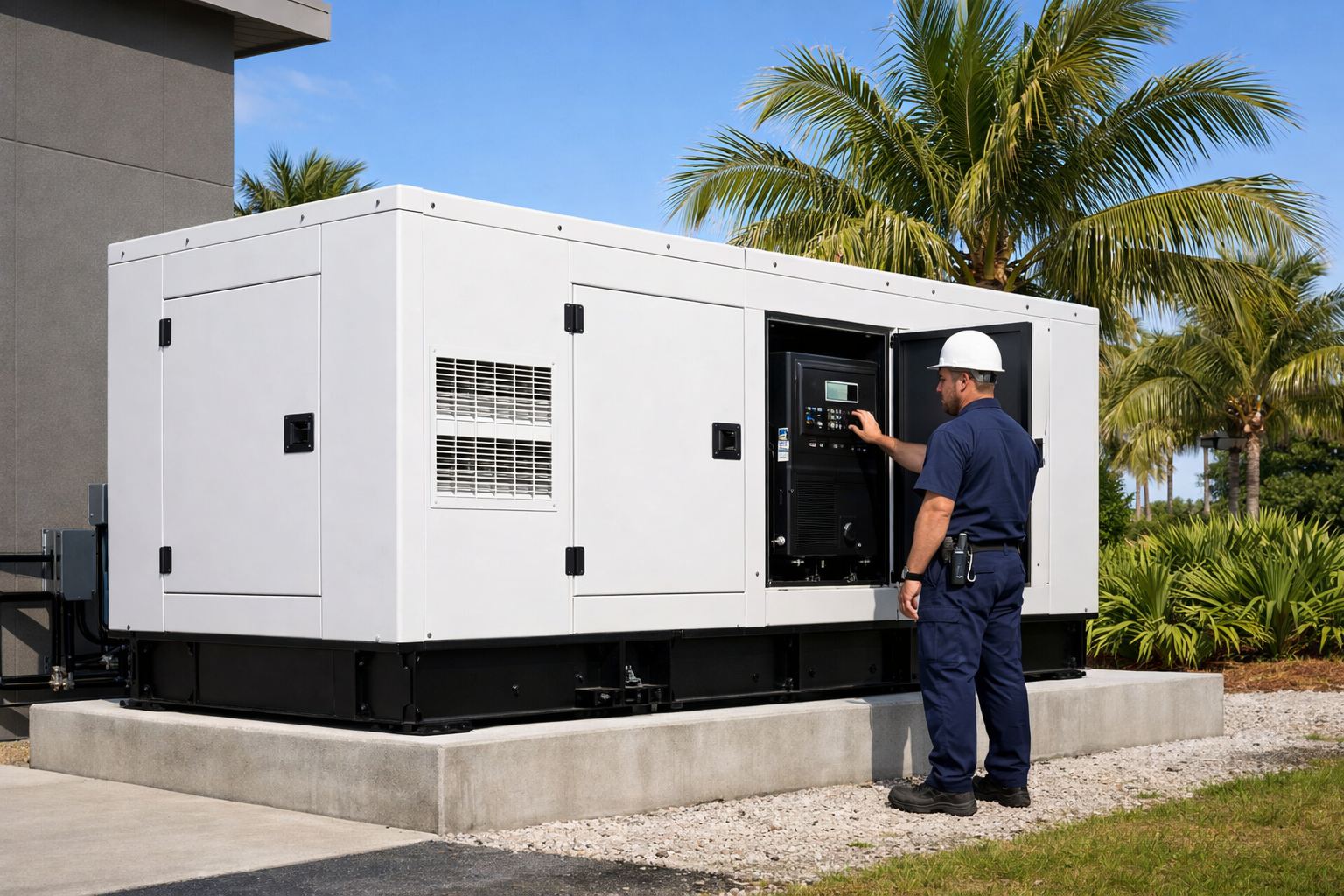
Generators & Backup Power
When the grid goes down, your life and business shouldn't. We size, install, connect and service standby and portable generators, with safe transfer switching every time.
- Range
- Portable – industrial
- Switching
- Manual & ATS
- Fuel
- Diesel · Gas · LPG
Lights on, fridge cold, business open
Outages from storms, line faults and maintenance happen. A properly sized and installed generator turns a crisis into a minor inconvenience.
We handle the complete job: load assessment, generator selection, concrete pad or mounting, fuel considerations, exhaust placement, transfer switch, wiring and commissioning. Then we keep it ready with scheduled servicing.
- Correct sizing, neither underpowered nor wasteful
- Transfer switches that prevent dangerous back-feed to JPS lines
- Automatic start within seconds of an outage (ATS systems)
- Service plans and 24/7 emergency repair
Generator services
Standby installation
Permanently installed generators that start automatically, for homes, businesses, clinics and hotels.
Portable hook-ups
Safe inlet box and interlock or manual transfer switch to run essential circuits from a portable unit.
Transfer switches
Manual and automatic transfer switches (ATS), correctly rated and integrated with your panel.
Repair & troubleshooting
Won't start, won't hold load, low voltage, controller faults. We diagnose and repair.
Servicing
Oil, filters, coolant, battery, belts and load testing on a schedule that suits your run hours.
Hybrid with solar
Combine generators with solar and batteries to cut fuel use and run hours.
Generator sizing calculator
Tick what you want to keep running during an outage. We'll estimate the generator size you need.
- Running load
- —W
- Peak start
- —W
Assumes the largest motor starts while everything else is running, plus 20% headroom. Typical wattages shown, so your appliances may differ. We confirm with a load survey before quoting.
Get an exact sizingPortable vs standby
| Feature | Portable + inlet | Standby with ATS | Solar + battery |
|---|---|---|---|
| Starts automatically | No | Yes, in seconds | Yes, instant |
| Powers whole house | Essentials only | Yes, if sized | Depends on battery size |
| Upfront cost | Lowest | Medium–high | High |
| Running cost | Fuel | Fuel + service | Near zero |
| Noise | Loud | Moderate (enclosed) | Silent |
| Long outages (days) | Needs refuelling | Excellent | Limited without sun |
Never back-feedPlugging a generator into a wall outlet ("suicide cord") can electrocute JPS line workers and destroy your appliances. Always use a proper transfer switch or interlock.
Generator best practices
Outdoors only
Exhaust contains carbon monoxide. Keep generators away from doors, windows and vents.
Exercise it monthly
Run under load for 20–30 minutes so it's ready when you need it.
Store fuel safely
Approved containers, away from heat. Use stabiliser for petrol.
Pre-hurricane check
Service, fill fuel and test before the season begins in June.
Battery health
Most standby no-starts are a weak battery. Replace every 2–3 years.
Don't overload
Stagger large loads. Start the AC after the fridge and pump settle.
Generator installation steps
Load survey
We measure and list what must run, and decide whole-house or essentials.
Select & site
Choose the unit, fuel type and location for airflow, noise and access.
Install & connect
Pad, transfer switch, wiring, earthing and fuel/exhaust setup.
Commission
Simulated outage test, load test and owner training.
Generator questions
What size generator do I need for my house?
Essentials (fridge, lights, fans, TV, pump) typically need 3–6 kW. Running one or two AC units pushes it to 8–15 kW. Whole-home standby with multiple ACs and a water heater can need 20 kW+. Try the calculator above, then we'll confirm.
Diesel, gasoline or LPG?
Diesel is durable and efficient for larger and commercial units. Gasoline suits small portables. LPG stores well long-term and burns cleaner. We'll recommend based on size, usage and fuel availability.
How often should a generator be serviced?
Typically every 100–250 run hours or at least once a year, whichever comes first, plus extra checks after long outages.
Do you repair generators you didn't install?
Yes. We service and repair most makes of portable and standby generators.
Related services
Be ready for the next outage
Sizing, installation and servicing, all in one call.